
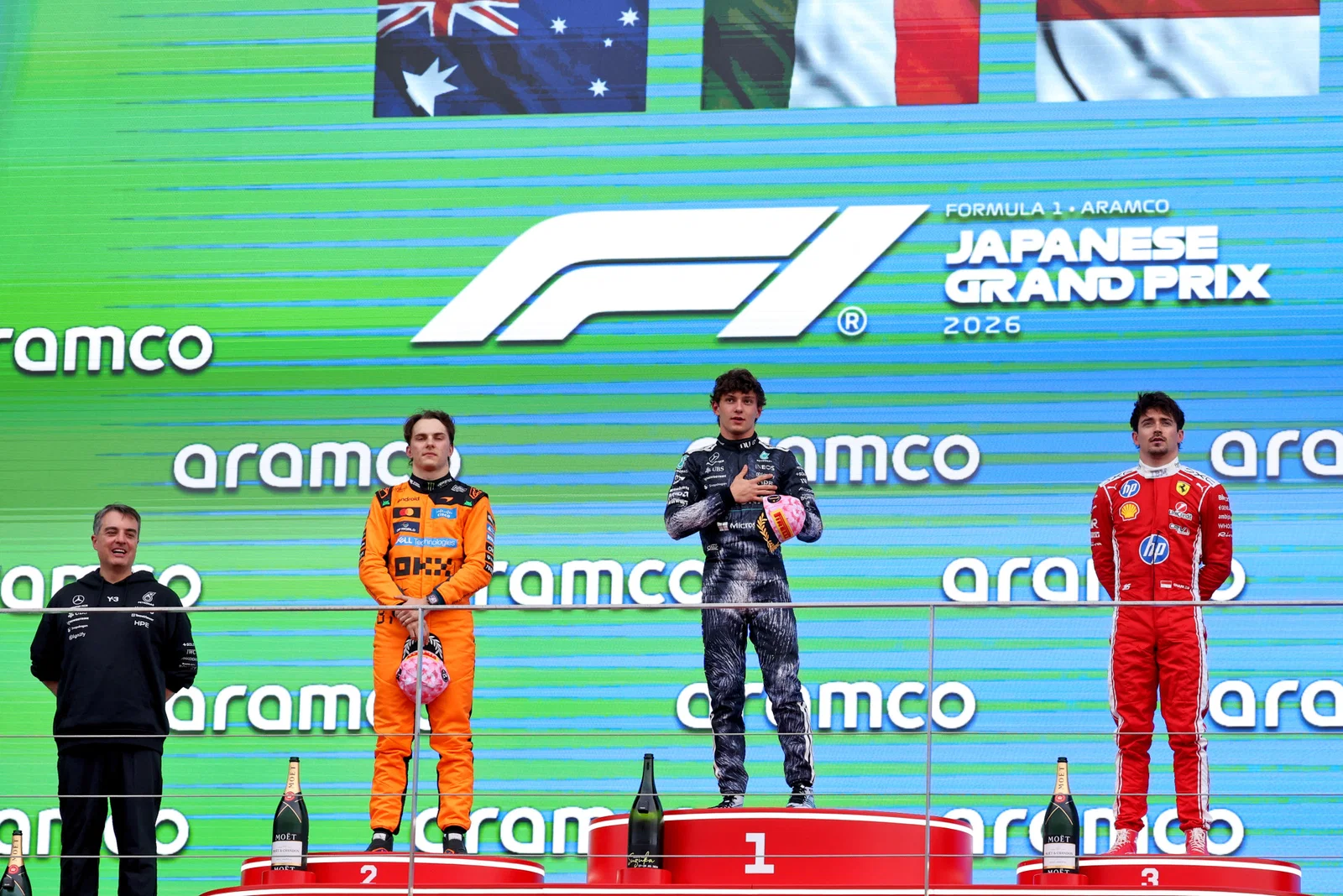
The 2026 F1 season delivered another chapter at the legendary Suzuka Circuit, where history was rewritten, fortunes reversed, and a new championship leader emerged. The 2026 F1 Japanese Grand Prix was highlighted by teenage sensation Kimi Antonelli and how he announced himself not just as a rising star but as a legitimate title contender.
Issues From the Start
Starting from pole position, expectations were high for Antonelli. But within seconds of lights out, the race appeared to slip through his fingers. A sluggish launch saw the young Italian tumble from first to sixth by Turn 1. An almost disastrous beginning for a driver aiming to build on his breakthrough victory at the Chinese Grand Prix.
Ahead, Oscar Piastri seized the moment brilliantly, overtaking both Mercedes drivers to take the early lead. Charles Leclerc slotted into second, followed by Lando Norris, George Russell, and Lewis Hamilton, with Antonelli trailing the pack.
At that stage, It looked as though two wins in a row was out of reach for Antonelli.
Early Battles
While Antonelli regrouped, Russell was already in attack mode. The Mercedes driver quickly dispatched Norris and then Leclerc within the opening laps, setting his sights on Piastri. By lap eight, Russell made a bold move at the final chicane to take the lead, only for Piastri to retaliate immediately on the main straight.
The race had settled into a rhythm, with Piastri maintaining a slender advantage and Russell lurking just behind. Meanwhile, Antonelli quietly began recovering.
Pit Stop Phase and the Turning Point
The first round of pit stops began around lap 18, with Piastri diving in early. Russell inherited the lead briefly before making his own stop on lap 21, a decision that would soon haunt him.
Moments later, the race turned on its head.
The Safety Car That Changed Everything
On lap 22, Haas driver Ollie Bearman attempted an agressive lunge on Alpine’s Franco Colapinto for 15th place. It went badly wrong. His car snapped onto the grass at 191mph, shredding through distance boards before burying itself in the barrier. Bearman was helped from the wreckage by two marshals before slumping to the floor. He was taken to the medical center, where X-rays confirmed a right knee contusion.
Antonelli, who had yet to pit, capitalized on the safety car’s yellow flags. Under the safety car, he gained a free stop and emerged at the front of the pack. In contrast, Russell, who had pitted just moments earlier, regretted his decision.
“Unbelievable”
Russell exclaimed over team radio, fully aware that the race had slipped away.
Strategy Meets Opportunity
This was the defining moment of the race. Antonelli’s timing was fortunate, but it was also a case of being in the right place at the right time. The safety car neutralized the field, allowing him to leapfrog competitors who had already stopped. Even Lewis Hamilton benefited from the timing, climbing into contention after he also delayed his stop.
When racing resumed on lap 28, the order had been reshuffled. Antonelli in first followed by Piastri, Russell and Hamilton. But it didn’t stay that way for long.
Restart Drama and Mid-Race Battles
As the green flag waved, Hamilton wasted no time overtaking Russell for third, while Antonelli began to stretch his legs out front.
Within just eight laps, the gap between Antonelli and Piastri ballooned to five seconds, a clear signal that the young Italian was in complete control. Behind them, battles raged fiercely. Russell fought back to reclaim position from Hamilton. Leclerc engaged in a tense duel with Russell. Norris remained within striking distance, waiting for opportunities
The midfield, too, saw its share of action, with Pierre Gasly delivering a standout performance for Alpine.
Final Laps: Leclerc vs Russell Showdown
The closing stages of the race featured a battle between Russell and Leclerc for the final podium spot.
Russell appeared to have secured third with a bold move at the chicane with just three laps remaining but Leclerc wasn’t done. The Ferrari driver struck back immediately, reclaiming the position at Turn 1 in a display of determination. It was a duel that kept things interesting until the end.
Antonelli Seals the Deal
Out front, however, there was no stopping Antonelli. The 19-year-old crossed the line a commanding 13.7 seconds ahead of Piastri, securing his second consecutive victory and etching his name into the history books. At just 19 years and 216 days, Antonelli became the youngest multiple Grand Prix winner in F1 history and the first teenager to lead the drivers’ championship.
In doing so, he surpassed the previous benchmark set by Max Verstappen, who was 20 when he achieved his second win.

Midfield Shake-Up and Missed Opportunities
Further down the order, strategy played a crucial role. Drivers like Esteban Ocon and Arvid Lindblad lost out after pitting before the safety car, while others, such as Liam Lawson, benefited. Gabriel Bortoleto briefly held a points position but dropped back later in the race. Meanwhile, Fernando Alonso endured another difficult outing, finishing 18th, while teammate Lance Stroll retired due to a suspected mechanical issue.
Verstappen later described his car as feeling like it was “driving without power steering,” continuing the ongoing struggles for Red Bull.
View the final results of the race here.
Championship Implications: A New Leader Emerges
Antonelli’s victory triggered a 13-point swing in the championship standings, propelling him past Russell into the lead. The Italian now holds a nine-point advantage, marking a significant shift in the title race. What once looked like a Mercedes intra-team battle has now evolved into a defining narrative of youth versus experience.
From a chaotic opening lap to a race-defining safety car, Suzuka once again proved why it remains one of F1’s most iconic battlegrounds.


